The literary community for readers who want to go deeper.
Our reading groups bring people together around books that reward close attention so you leave feeling curious, intellectually alive, and able to find meaning in literature that speaks to your life.
Close Reading NYC is a literary programming company based in New York City, founded in 2024 by Elena Navarrete. Our core offering is structured reading groups for people who want to engage seriously with great books, without going back to grad school.
We offer the depth of a great college literature seminar, without the grades. Our groups read demanding texts closely: attentive and serious, without being stiff. You leave each session having noticed something in the language you wouldn't have caught alone.
This will be a good fit if:
You read books but rarely get to really talk about them
You want to get past “I liked it” to why it works on you
You want intellectual engagement that's rigorous but not academic
You want to meet cool, friendly people in NYC who are excited to talk about books and ideas
Who's in the room
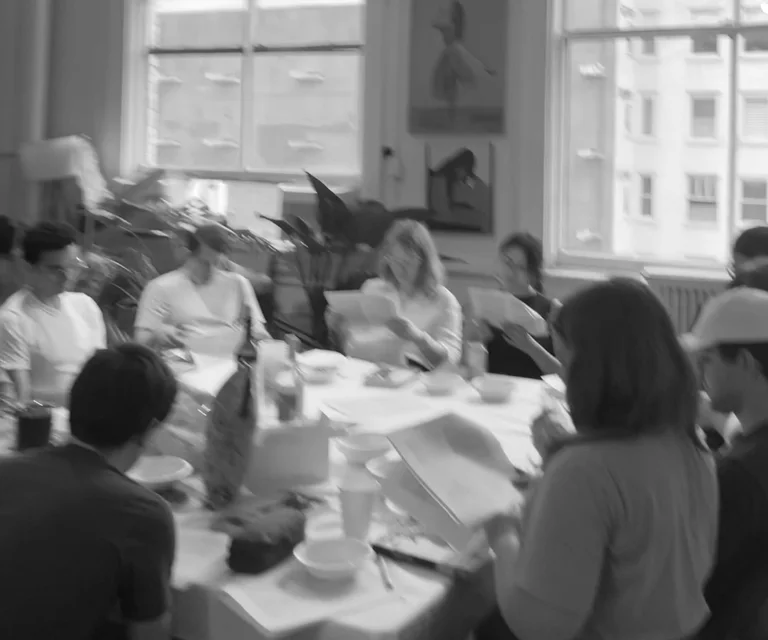
Engineers, designers and product managers. Lawyers and filmmakers. English majors who now run startup operations. Retirees who finally have time for the long books. Most come alone. Everyone comes curious.
No background in literature needed. Reading groups ask you to complete the assigned reading before each session. Workshops and events have their own preparation details, and some require no advance reading.
Reading groups
What happens in a reading group?
Prompts guide you toward specific details in the language, which we use to build the conversation together.
Between sessions
We read one book together over three to eight weeks, with around 60–100 pages of reading per week. The reading load is listed on each group's page. Before each session I send you a few questions by email to guide your reading. You do not need to have read the book before we start.
In the room (90 minutes)
Explore the session, step by step
Read and noticeWe start with a passage and prompts from the facilitator, who gives us something specific to look for: imagery, metaphor, or a shift in tone. We read in silence and note what we find.
Small-group discussionIn groups of three or four, we look at a scene through a specific lens, then report back to the room.
Whole-group conversationWe bring what we found together and ask the bigger questions about the book, with something concrete to point to.
This is an example of the kind of exercise we might do in the first 15 minutes of a reading group.
These two passages are from Mary Shelley's Frankenstein. In the first, the explorer Robert Walton finds the scientist Victor Frankenstein on the ice; in the second, Victor encounters the monster he created.
Observe
1.Read each passage twice. First, mark details about the body. Then look for words that carry a feeling.
Body details are not marked.
Feeling words are not marked.
Walton finds Victor on the ice
His limbs were nearly frozen, and his body dreadfully emaciated by fatigue and suffering. I never saw a man in so wretched a condition… I never saw a more interestingcreature: his eyes have generally an expression of wildness, and even madness… He must have been a noblecreature in his better days.
Victor sees what he created
He bounded over the crevices in the ice… I perceived, as the shape came nearer (sight tremendous and abhorred!) that it was the wretch whom I had created. I trembled with rage and horror… his countenance bespoke bitter anguish, combined with disdain and malignity.
Mary Shelley, Frankenstein (1818)
More to consider
Find patterns
2.In each passage, which comes first: the body or the feeling?
3.What words do the two passages share?
Walton gives us Victor's frozen limbs, emaciated body, and wild eyes: specific details of someone close to death. Victor, by contrast, first sees a "shape." Even "countenance" gives us little physical detail before the description turns to anguish, disdain, and malignity. The contrast raises a question: does Victor himself seem almost in need of reanimation? The shared words complicate the distinction further: Walton calls Victor a "creature" and "wretched"; Victor calls his creation "the wretch."
Connect
4.Why might the novel describe Victor's body so specifically, while his creation first appears as a "shape"?
5.How does Victor's horror shape what he lets us see of the being he created?
The creator seems suspended between life and death, while the life he created is harder for us to see. That reversal brings the novel's act of animation back into the description of Victor himself. How secure is the boundary between creator and creation?
That's close reading. We do it together, one book at a time.
Winter groups start in late January and February, with morning and evening options.
Reading groups are capped at 15 readers.
The Winter lineup is announced. As our community has grown, we're giving our mailing list a two-week head start on registration, plus 10% off during the early-access window.
· Days, times and seats go to the list first
Get locations, prices, group sizes, your priority registration link, and your discount code by email.
· Public registration opens
The priority window ends. Full season details and registration become available to everyone.
A winter of Morrison, Steinbeck, Shakespeare, and Woolf, with Latin American short fiction by García Márquez, Borges, and Cortázar, plus a philosophy series on aesthetics.
“For the first time in my adult life, I actually feel like I have a meaningful opinion I can share with others beyond just judging a book as 'good' or 'bad.'”
The Odyssey
“I feel like I'm engaging with this novel (and others I'm reading!) on a deeper, more attentive level.”
Anna Karenina
“This was my third time reading The Odyssey, but I got so much more out of it doing the Close Reading! The class was well paced and the conversation was high quality. Elena is a great guide and her enthusiasm is infectious!”
The Odyssey
“It reminded me why I love close reading and reading in conversation with others. It just felt good.”
Our core offering: structured reading groups that take us deep into one book over several weeks. Close attention to language, then an open conversation about the questions it raises.
Experts from different fields bring our philosophy of attention, curiosity, and practice to their disciplines, not just classic literature. Each facilitator adapts methods to their material, bringing different works together around a shared question.
One-off workshops for practicing close reading. A focused encounter with language, form, and the choices a writer makes, with exercises that give you a way into the text.
Wine and close reading, cultural outings, and community evenings. Shared experiences that bring our practice of attention into conversation with the world beyond the page.
Standalone 90-minute literary workshops, in person or fully virtual. One short text, a sharper and more connected team. Trusted by teams at companies like Block.
Groups meet weekly, either at 80 Fifth Avenue in New York (unless otherwise noted) or online on Google Meet. Check your group's page for the schedule, location, and preparation details when registration opens.
How many people are in a group?
Reading groups are capped at 15 readers. Series may have different group sizes depending on the format; each series page lists its capacity.
Can I come alone?
Yes. Most people do.
What if I miss a session?
Keep up with the reading and join the next week. Groups are built so you can pick right back up.
How much does it cost?
Groups usually range from $35 to $50 per session. Morning and virtual groups are usually toward the lower end of that range. Exact prices are listed on each group's page when registration opens. Full refunds are available up to 14 days before the group starts. Read the refund policy